Description
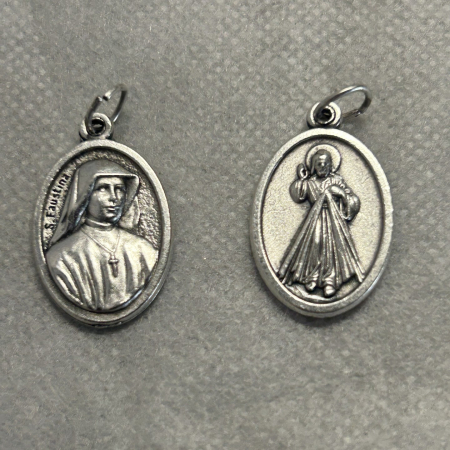
MEDAL – SACRED HEART / OUR LADY OF MT CARMEL SILVER OXIDE (22mm x 15mm) – Designed and Made in Italy
The story of Our Lady of Mount Carmel originates in the Holy Land and is deeply tied to the Old Testament prophet Elijah. It centers on Christian hermits who lived on Mount Carmel, a Marian apparition to Saint Simon Stock in 1251, and the introduction of the Brown Scapular.
The Origins: Mount Carmel and Elijah
The history of this devotion goes back to the mountainous region in Israel overlooking the Mediterranean Sea. In the Bible, it is the legendary site where the prophet Elijah defended the faith against the priests of Baal and prayed to bring an end to a severe drought.
Inspired by Elijah, a group of Christian hermits retreated to these same mountain caves in the late 12th and early 13th centuries to live a life of prayer. They built a small chapel in the center of their hermitages and dedicated it to the Virgin Mary, honoring her as the “Lady of the Place”. This marked the beginning of the Carmelite Order, who view Mary as their patroness and spiritual mother.
The Vision of Saint Simon Stock
As the Carmelites expanded into Europe, they faced intense persecution and hardships. According to tradition, on July 16, 1251, the Virgin Mary appeared to Saint Simon Stock, who was the Prior General of the Carmelite Order in England.
During this apparition, she presented him with the Brown Scapular—a devotional garment made of two small pieces of brown wool connected by strings. She promised her maternal protection, stating that whoever died wearing this garment would be preserved from eternal damnation.
The Brown Scapular Today
Today, the Brown Scapular is worn by millions of Catholics worldwide as a symbol of their consecration to Mary, their commitment to live a virtuous life, and their trust in her spiritual protection.
Feast Day and Legacy
Feast Day: The story and its promises are celebrated globally on July 16th.
Patronage: Beyond the Carmelite Order, she is widely revered as the patron saint of sailors and fishermen, and in some Latin American countries, she is the patron of the armed forces and the national police